Tutorial 02: TENAX vs SMEV (extreme value method)
Import all libraries needed for running TENAX and SMEV
[1]:
from importlib.resources import files
import numpy as np
import pandas as pd
import matplotlib.pyplot as plt
# Import pyTENAX
from pyTENAX import tenax, smev, plotting
Let’s initiate TENAX class and SMEV class with given setup.
[2]:
# Initiate TENAX class with customized setup
S = tenax.TENAX(
    return_period=[
        2,
        5,
        10,
        20,
        50,
        100,
        200,
    ],
    durations=[10, 60, 180, 360, 720, 1440], #durations are in minutes and they refer to depth of rainfall within given duration
    time_resolution=10,  # time resolution in minutes
    left_censoring=[0, 0.90], # left censoring threshold
    alpha=0.05, #dependence of shape on T depends on statistical significance at the alpha-level.
    min_rain = 0.1, #minimum rainfall depth threshold
)

# Initiate SMEV class with customized setup following TENAX
S_SMEV = smev.SMEV(
    return_period=S.return_period,
    durations=S.durations,
    time_resolution=5,  # time resolution in minutes
    min_rain=0.1,
    storm_separation_time=24,
    min_event_duration=30,
    left_censoring=[S.left_censoring[1], 1],
)
Load same test data as in Tutorial 01.
[3]:
# Load precipitation data
# Create input path file for the test file
file_path_input = files('pyTENAX.res').joinpath('prec_data_Aadorf.parquet')
# Load data from csv file
data = pd.read_parquet(file_path_input)
# Convert 'prec_time' column to datetime, if it's not already
data["prec_time"] = pd.to_datetime(data["prec_time"])
# Set 'prec_time' as the index
data.set_index("prec_time", inplace=True)
name_col = "prec_values"  # name of column containing data to extract

# load temperature data
file_path_temperature = files('pyTENAX.res').joinpath('temp_data_Aadorf.parquet')
t_data = pd.read_parquet(file_path_temperature)
# Convert 'temp_time' column to datetime if it's not already in datetime format
t_data["temp_time"] = pd.to_datetime(t_data["temp_time"])
# Set 'temp_time' as the index
t_data.set_index("temp_time", inplace=True)
temp_name_col = "temp_values"
Repeat the preprocessing from Tutorial 01.
We once again focus only on 10-minute rainfall depth.
[4]:
data = S.remove_incomplete_years(data, name_col)

# get data from pandas to numpy array
df_arr = np.array(data[name_col])
df_dates = np.array(data.index)
df_arr_t_data = np.array(t_data[temp_name_col])
df_dates_t_data = np.array(t_data.index)

# extract indexes of ordinary events
# these are time-wise indexes =>returns list of np arrays with np.timeindex
idx_ordinary = S.get_ordinary_events(data=df_arr,
                                     dates=df_dates,
                                     name_col=name_col,
                                     check_gaps=False)

# get ordinary events by removing too short events
# returns boolean array, dates of OE in TO, FROM format, and count of OE in each years
arr_vals, arr_dates, n_ordinary_per_year = S.remove_short(idx_ordinary)

# assign ordinary events values by given durations, values are in depth per duration, NOT in intensity mm/h
dict_ordinary, dict_AMS = S.get_ordinary_events_values(data=df_arr,
                                                       dates=df_dates,
                                                       arr_dates_oe=arr_dates)

dict_ordinary, _, n_ordinary_per_year = S.associate_vars(dict_ordinary,
                                                         df_arr_t_data,
                                                         df_dates_t_data)

# Your data (P, T arrays) and threshold thr=3.8
P = dict_ordinary["10"]["ordinary"].to_numpy()  # Replace with your actual data
T = dict_ordinary["10"]["T"].to_numpy()  # Replace with your actual data
blocks_id = dict_ordinary["10"]["year"].to_numpy()  # Replace with your actual data
# Number of threshold
thr = dict_ordinary["10"]["ordinary"].quantile(S.left_censoring[1])
Repeat TENAX model (same as Tutorial 01)
Note: This doesn’t run bootstrapping for TENAX uncertainty.
[5]:
eT = np.arange(
    np.min(T)-4, np.max(T) + 4, 1
)  # define T values to calculate distributions. +4 to go beyond graph end

# magnitude model
F_phat, loglik, _, _ = S.magnitude_model(P, T, thr)

# temperature model
g_phat = S.temperature_model(T)

# Sampling intervals for the Montecarlo
Ts = np.arange(np.min(T) - S.temp_delta,
               np.max(T) + S.temp_delta,
               S.temp_res_monte_carlo)

#  mean n of ordinary events
n = n_ordinary_per_year.sum() / len(n_ordinary_per_year)

# estimates return levels using MC samples
RL, _, P_check = S.model_inversion(F_phat, g_phat, n, Ts)
SMEV model
[6]:
# estimate shape and  scale parameters of weibull distribution
smev_shape, smev_scale = S_SMEV.estimate_smev_parameters(P, S_SMEV.left_censoring)
# estimate return period (quantiles) with SMEV
smev_RL = S_SMEV.smev_return_values(
    S_SMEV.return_period, smev_shape, smev_scale, n.item()
)

smev_RL_unc = S_SMEV.smev_bootstrap_uncertainty(P, blocks_id, S.niter_smev, n.item())
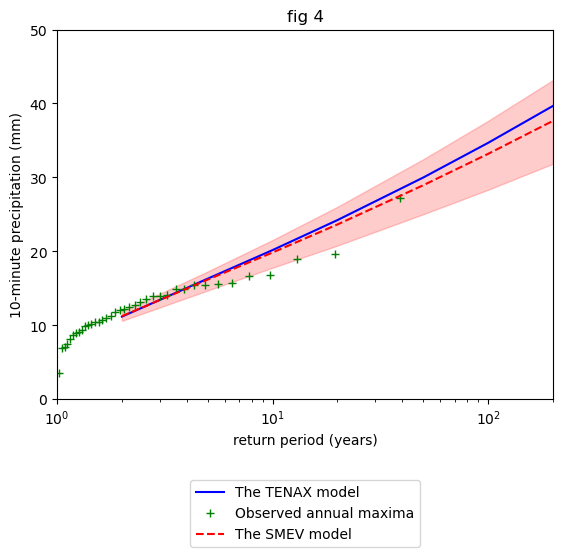
Plot results TENAX vs SMEV
Note, we excluded TENAX uncertainty here as it would take too long to run.
[7]:
AMS = dict_AMS["10"]  # yet the annual maxima
plotting.TNX_FIG_valid(AMS,
                       S.return_period,
                       RL=RL,
                       smev_RL=smev_RL,
                       RL_unc=[],
                       smev_RL_unc=smev_RL_unc)
plt.title("fig 4")
plt.ylabel("10-minute precipitation (mm)")
plt.legend(loc="upper center", bbox_to_anchor=(0.5, -0.2))
plt.show()